
I said what i said until you tell me to rehearse it. A take on Hong Sang-soo's The Day She Returns (2026)
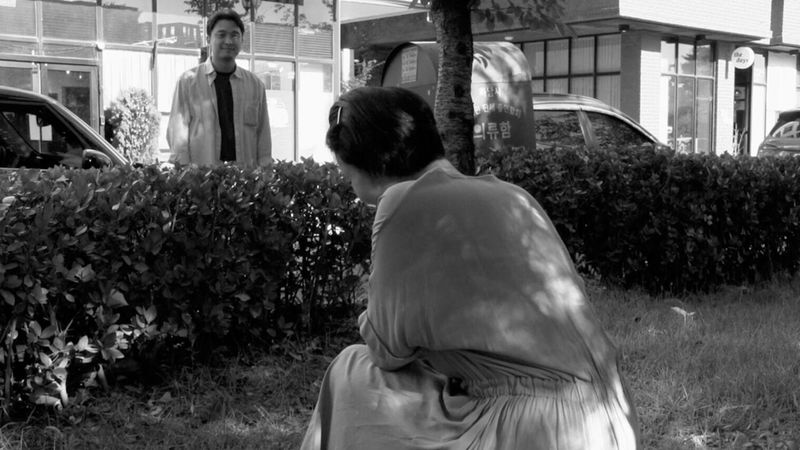

Where do images come from?
It might not begin with the camera; instead, it could lie in the space between seeing and remembering.
Perhaps they’re coming from behind our eyes, as perception suggests, but maybe they also emerge as a trace of something previously experienced, misinterpreted, and compelled to transform into a form of language.
An image is never free of guilt. It comes into being after being influenced by memory, logic, desire, and the violence of interpretation. By meaning.
Therefore, to inquire about the source of images is to question how meaning is created.
Meaning does not dwell within an image like a soul within a body; it more closely resembles how identity exists within a person—formed, gathered, and negotiated through the repetition of ideas, framing, societal pressures, and the need to articulate oneself. Barthes, frequently referenced in discussions about semiotics, noted that images are never devoid of content; they always bear codes and are shaped by interpretive frameworks even before we engage with them fully.
Hong Sang-soo's The Day She Returns begins with this ambiguity. The film portrays the image as something fluid, crafted in the space between experience and its recounting. This film is an excellent exercise in understanding meaning and the act of perception. Watching Hong's cinema reveals how characters realize that language has already advanced beyond them. They articulate thoughts, only to later comprehend the implications of their words.
The story centers on an actress, played by Song Seon-mi, who has resumed her career after a twelve-year hiatus. She engages with three younger female journalists in a restaurant. While the scenario appears straightforward, Hong transforms this mundane setting into an exploration of how meaning can unravel. This is why I claim that films can be both deceptively simple and incredibly complex.
At the heart of the film is the actress, who has returned to her profession after a lengthy absence marked by divorce, a daughter, and a career that has been paused long enough to become material for her biography. The public narrative of her life is primed for consumption. She has returned, faced hardships, and accepted a role in an independent film. These elements should suffice for a press event, and the film places her in one: a German restaurant, interviewing three younger female journalists across three scheduled discussions.
The setup is basic, almost suspiciously so. Hong frequently starts with a social structure that seems innocuous; he has always enjoyed small talk. It often initiates with a meal, a visit, a walk, or a drink that evolves into dialogue. Here, it is the interview—a polite mechanism for converting a person into something consumable. The actress is anticipated to discuss her professional life, and possibly touch on her personal experiences if the interviewer is bold enough to approach that topic. She must present herself in quotable sentences that can be edited and taken away. Every interview starts with the typical constraints of publicity, where the questions have a predetermined format and the responses are expected to conform. However, the actress often veers off the expected path. She ask about the journalists’ opinions on the film, which leads to a more relaxed dialogue. Private matters start to surface before they are truly welcomed. A vulnerability emerges but is quickly concealed. She communicates with a slight unease, aware of the expected public demeanor yet struggling to fully adhere to it. There are few interruptions, slight chuckles, evasions, and abrupt shifts in focus.
The first interview reveals the film's approach. A younger woman poses a question about divorce, carrying a hint of professional insensitivity. The actress responds, but soon the interviewer also begins to share personal insights. The gap between the interviewee and the interviewer diminishes. The one who came to extract insights from the actress finds herself drawn into the same unstable territory of personal revelation. Hong does not create overt dramatic tension; instead, he allows the natural awkwardness of real dialogue to unfold, where closeness often develops before anyone has determined if it’s appropriate.
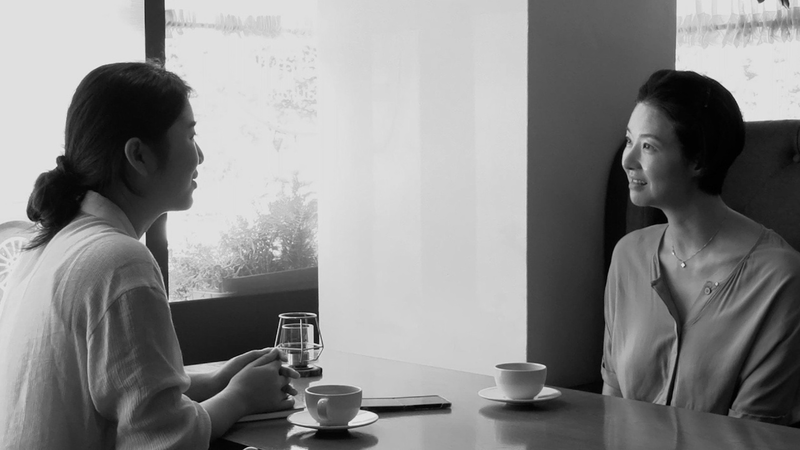
The formal pattern is repeated with another journalist and yet another polite interaction with the same actress. This repetition does not yield clearer insights. Similar questions may reappear multiple times, but the actress approaches them from a different perspective each time. A gentler interviewer, a varied pace, a drink, a break, or the exhaustion from having spoken too much; all of these factors influence what can be articulated. Meaning does not stem only from language; it is also shaped by the circumstances that allow a language to be made in the first instance.
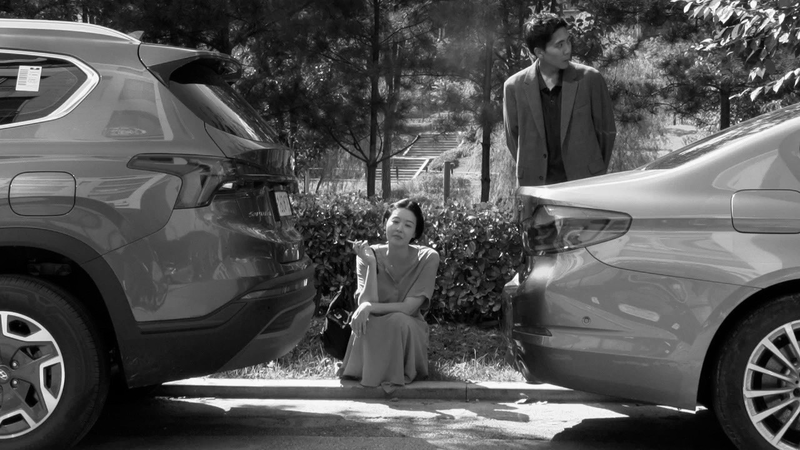
The third act is the film’s entire thesis statement. Following the interviews, the actress participates in an acting class to reenact what just happened. The film reflects back on itself. Life becomes the material. The interview transforms into a script. The woman who was responding to questions must now portray the woman who answered them. At first, this seems like a straightforward memory exercise; she only needs to repeat what she said. Yet, this simplicity is what makes the scene profoundly impactful.
She struggles to do it completely. The words elude her. The response she previously gave, particularly her guidance to the youth, suddenly feels out of reach. In the restaurant, it had seemed natural enough, influenced by the conversational mood, the drink in front of her, the journalist's presence, and the subtle pressure to appear generous and wise. However, when she attempts to articulate it again in a different setting, under a different gaze, the sentence loses its essence. It no longer feels connected to its origin. Though she once expressed it, it does not return to her as something she can easily claim.
So, where do images comes from?
In The Day She Returns, they emerge at the point where an experience can no longer be retrieved in its original form. Memory strives for life and slightly misses it. That miss transforms into the image. Hong’s film uncovers meaning in that space: not in the event itself, but in the flawed attempt of how human try reclaim it.
Comments
No comments yet. Be the first to comment!